
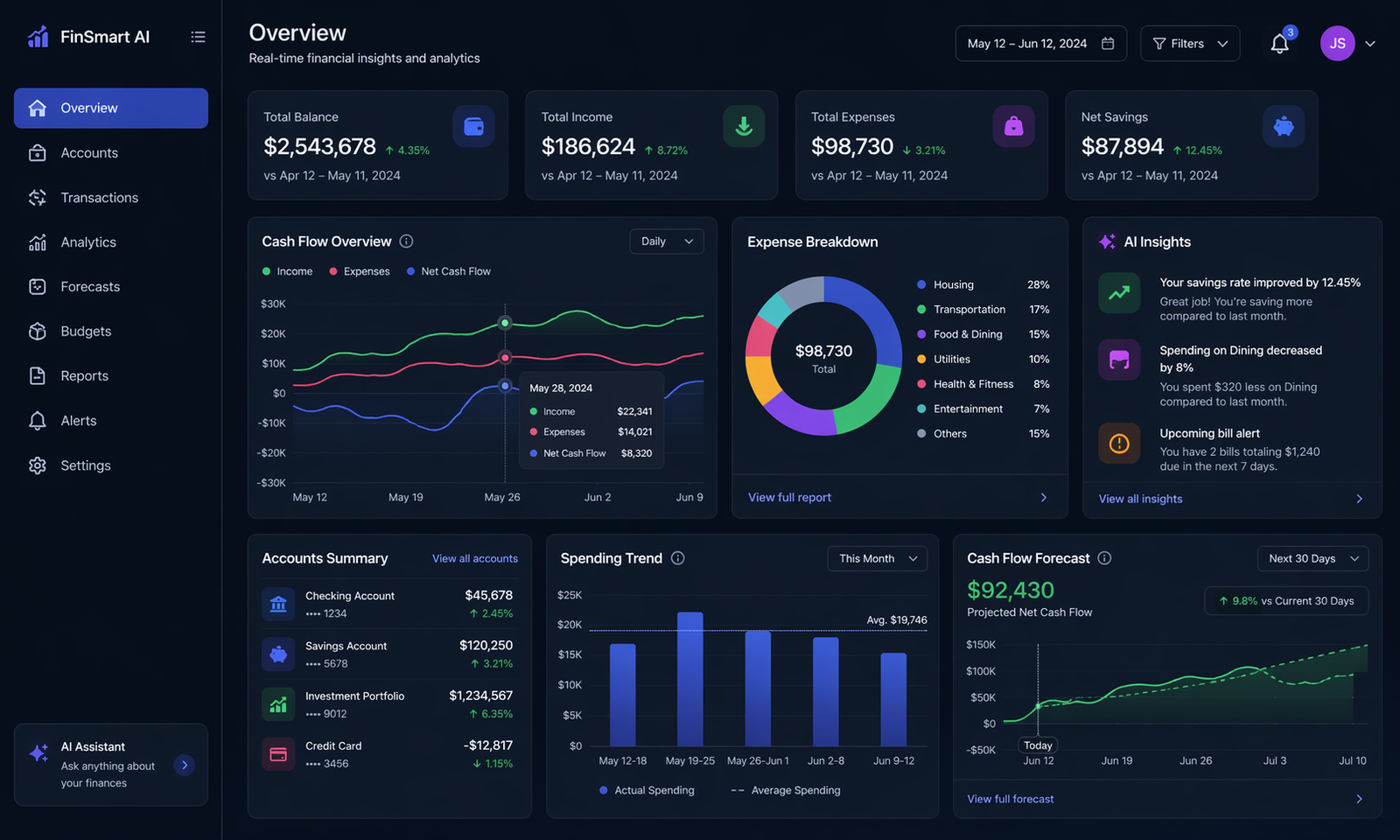
Artificial Intelligence is fast changing the financial fabric of contemporary business. The work of large teams of analysts, accountants and executives can now be done by smart systems that have the ability to analyze, forecast and make financial decisions within seconds. AI CFOs and autonomous finance cease to be a product of the future anymore, as they actively influence the way companies operate, compete, and develop in a data-driven economy.
What are AI CFOs and Autonomous Finance Systems?
It is a high-tech system that copies and improves the work of a conventional Chief financial officer; AI CFOs are sophisticated digital solutions that mimic and complement the work of a classic CFO. They are machine-learned, big data-driven, and automatically-controlled systems that handle cash flow, long-term financial strategy, and much more. Autonomous finance goes further to allow systems to make independent decisions on the basis of insights and therefore does not require human intervention all the time.
Essential Roles of AI CFOs.
AI CFOs also work around the clock generating and analyzing data on a large scale and are not exhausted or slowed down by large volumes of financial data. They track transactions, trends, and produce insights that can keep businesses financially healthy. These systems are dynamic and unlike the traditional method, they can learn with time as new data is fed and enhance accuracy. They also have the capability to build up the various financial situations, enabling businesses to prepare for uncertainty and make swift decisions.
The Autonomous Finance and Business.
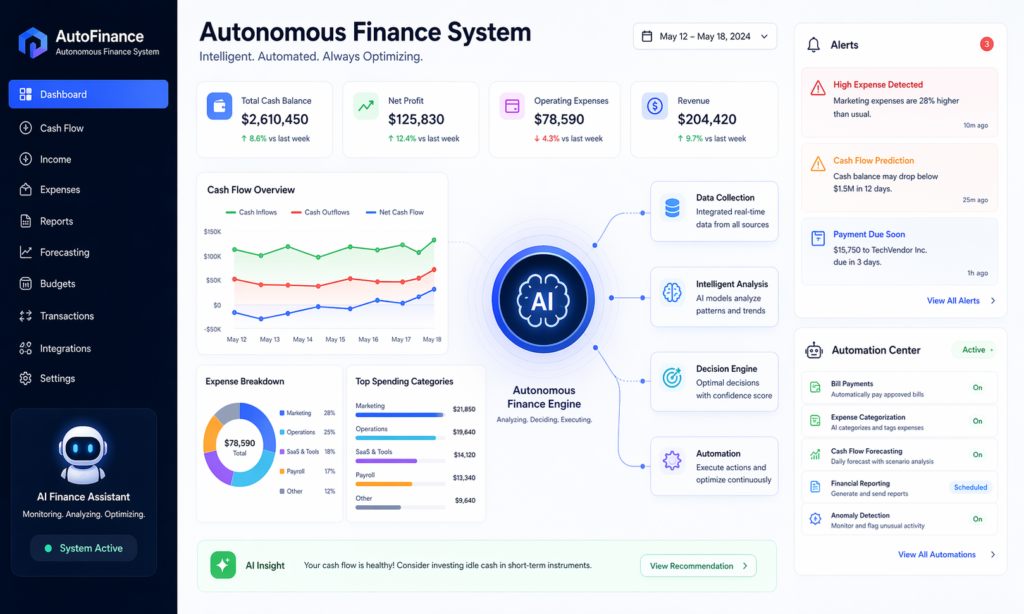
Independent finance makes financial processes a self-sustaining system. It automates such repetitive processes as invoicing, payroll and expense tracking and also makes higher-level decisions such as budget allocation and investment optimization. This opens a more dynamic financial landscape within which enterprises are able to react to market dynamics immediately without having to wait until the manual approvals or analysis.
Major Advantages of AI-based Financial Management.
- Quickly make financial decisions involving real time data processing.
- Major decrease in the error of handwork and inefficient work.
- Reduce expenses by cutting down on the use of big finance departments.
- Enhanced predictability with predictive analytics.
- Financial systems that can be expanded as the business expands.
Business Effectiveness.
Financial management AI has a great impact on the operational efficiency as it automates time-consuming processes. The companies do not have to wait to get monthly or quarterly reports to realize their financial status. Rather, they can access the real-time insights at a glance hence they are able to make prompt decisions and be sure of their decisions. This pace and productivity bring about a competitive edge particularly in industries which move at pace.
Strategic Benefits of Companies.
In addition to efficiency, AI CFOs offer a strategic advantage. They assist leaders in making well-founded decisions, minimize financial risks and discover new areas of growth. These systems may recommend the best investment options, cost reduction, and revenue improvement by examining the patterns and trends. This enables businesses to shift to proactive and predictive financial management, as opposed to reactive financial management.
Problems and Threats of Autonomous Finance.
- Reliance on quality and correct data entries.
- Poor human intuition with complex decision making situations.
- Possible cyberattacks to financial systems.
- Algorithms and ethical issues surrounding bias and transparency.
- Doubtful regulatory environment of AI-powered financial activities.
Effective Risk Management.
Although there is a lot that autonomous finance is doing good to businesses, there are also new risks that a business has to address with caution. The quality of data is critical to the implementation of AI in companies, and companies must make sure that it is clean, secure, and reliable. It is also important to establish high levels of cybersecurity to ensure breach and attacks of sensitive financial information is avoided.
Significance of Human Supervision.
Although AI is capable of doing it, human supervision is still needed. Money choices may be ethically based, market savvy and strategic thinking that machines may not be able to duplicate completely. The combination of both the data-driven work done by AI and human advice is the right balance that guarantees improved results and minimizes the chances of expensive errors.
Fast Adoption of AI CFOs by industries.
The use of AI CFOs is increasing rapidly in various sectors because companies are looking to be efficient, scalable, and smarter in their financial management. Industries with a huge amount of transactions and complicated financial systems are spearheading this change. Starting with fintech startups and going up to global businesses, enterprises are incorporating AI into their financial systems to keep competitive and future-proven.
H3: In Areas with Rapid Adoption.
Financial systems based on AI are becoming more popular in such industries as e-commerce, banking, SaaS, and manufacturing. AI assists in e-commerce in controlling dynamic prices, inventory expenses, and profit margins. It is used in banking and fintech to improve fraud detection, risk assessment and compliance. AI CFO is used by SaaS companies to maximize subscription income and customer lifetime worth, and manufacturers enjoy forecasting costs and financial planning of their supply chain. This broad usage underscores the flexibility and powerfulness of autonomous finance.
Conclusion
The use of AI CFOs and self-directed finance systems is transforming the business approach to money. These technologies can allow companies to act more efficiently and strategically by automating processes, making them more accurate, and allowing them to make real-time decisions. Nevertheless, AI in finance has a deeper potential in collaboration, i.e., machine intelligence with human expertise. Such a balanced approach will allow businesses to be more prepared to deal with challenges and pursue opportunities and succeed in the growing digital economy.
Frequently Asked Questions AI CFOs and Autonomous Finance.
1. What is an AI CFO?
An AI CFO is a technological platform which employs artificial intelligence to regulate financial activities, forecasting and decision-making in companies.
2. What is autonomous finance?
Autonomous finance, AI and automation can be used to analyze financial data and make decisions without the direct participation of a person.
3. Are there any AI CFOs who can be trusted?
They are very dependable in the presence of the correct information and right supervisory measures.
4. Does AI CFO have applications in small businesses?
There are indeed numerous solutions, which can be scaled up and have a low price, which can be offered to startups and small businesses.
5. Which is the largest benefit of AI in finance?
The greatest benefit is real-time insights and quicker and more precise decision-making.